Space Datacenters

Apparently the whole “space datacenters” idea is a thing that some people are buying into.

Again.

I felt compelled to comment.

Now, I haven’t actually gone out and done the numbers or anything, or thought about it very hard or anything, but I have two big concerns that I suspect may not have been fully taken into account by people advocating for this “solution”.

(there are other concerns, but these are the two that immediately leap into my mind)

1. Cooling. Space isn’t really exactly “cold” like the popular conception says. Getting rid of heat is actually a fairly big problem, and it’s very easy to overheat things: In space, there’s no conduction of convection – the only way to dissipate heat from your GPU cluster is via radiation. This is why the ISS has huge radiators on it to dissipate the heat they generate. Otherwise things would get pretty toasty – by which I mean “unsurvivable” – pretty quickly, since every watt of heat generated would just add up.

Radiation is the least efficient way of dissipating heat. It also requires a lot of surface area for the heat to radiate from. That’s why those radiators on the ISS are so big.

Science fiction tends to completely ignore these facts, or at best it’ll handwave some magical heat dissipation solution that’s about as practical in the real world as inertial dampeners. But the reality according to our current understanding of physics would look quite different to what you see in the movies: Those huge fusion engines or matter/antimatter reactors your ship uses are going to generate a fucktonne of heat. And that’s going to require some huge radiators if you don’t want to literally cook your crew surprisingly quickly. In reality those star destroyers would look very different because they’d need a ton of radiators. In fact, heat is one of the prime reasons why stealth in space is so extremely difficult, bordering on impossible if your ship is crewed and you want it to stay that way.

And it’s not just about crewed vessels, either. A machine might be able to run a lot hotter, but electronic components tend to not like excessive heat either. Plastics and solder will melt a long time before your superstructure does.

Fun fact: Datacenters, and especially processors and GPUs, generate a lot of heat.

Sure, it’s possible to dissipate the heat from a bunch of GPUs with radiators, but I strongly suspect that for a concentrated cluster of GPUs, like you’ll want to have for, say, “AI” datacenters, will require a LOT of surface area for radiators – far more per square meter of usable area than the ISS, which isn’t filled to the brim with heat-generating processors.

Did I mention that convection isn’t a thing in space? So of course your CPU/GPU fans are useless there. You’ll need to use some more complex solution like heat pipes and/or liquid cooling. Also don’t forget to account for the microgravity environment when you design that liquid cooling system,

And that’s before we start talking about surface area required for solar cells to power these GPUS – which are also notoriously power-hungry.

TL;DR: I haven’t done the math, but I suspect your GPU-cluster-in-space-datacenter is going to have much more area and weight used on radiators and solar panels than it will on GPUs.

2. Lifecycle. I think you might be surprised how long commodity computer hardware doesn’t last. And even server-grade hardware that’s designed to run 24×7 doesn’t last all that long, really. A hard disk has an average lifespan of something like 5 years IIRC.

And that’s in an environment where it’s shielded from a ton of radiation by earth’s atmosphere and ozone layer. In space it will last even less time due to the cosmic rays and the solar flares and whatnot.

Unless you spend a ton of money hardening it, of course.

Fun fact: when the rest of the world was using gigahertz circa-pentium3 machines, the fastest radiation hardened machine you could buy was something on the order of a 486. A lot of the nasa stuff was running on radiation-hardened 386 machines for a LONG time after the 386 was totally obsolete on earth. I’m pretty sure the space shuttle used a rad-hardened 386 right up until its last flight in 2011. I’d be unsurprised to learn that there are still 386s running on the ISS.

I did a quick search and found some more modern examples, such as the a radiation-hardened ARM chip, the SAMRH71. Ooh yay, ARM! A modern architecture! Just what we need, right?

It runs at 100Mhz. with 1MB RAM and 128K of flash. Ooo such impressive stats! I’ll leave it as an exercise to the reader to compare those numbers with the requirements for any machine learning model currently being spruiked by the industry.

I also found the RAD5500, which is a 64bit powerpc chip that can run up to the blinding speed of 450mhz! Wow! With only 6 of those you could almost do as many FLOPS as a single core of my 12-core laptop!

I didn’t look very hard. I’d be unsurprised if there are faster rad-hardened machines out there. But I can pretty much guarantee that they’re going to at least an order of magnitude slower than the cutting edge, and they’ll cost at least an order of magnitude more than the equivalent server-grade hardware.

But there are other options! The cubesat approach to radiation hardening is to do nothing – you just stick a mobile phone in there and hope that it doesn’t get fried by cosmic rays on day one.

Fun fact: cubesats have a much higher failure and DOA rates than most other satellites. There’s probably no correlation there, though. Could just be a coincidence.

Alternatively, you could just put two or more identical not-hardened machines up there, and use the redundant systems and have things like voting mechanisms to do a sort of “software radiation hardening”. I seem to recall reading about experiments with that approach that indicated it worked. And it’s only ~double the cost! And double the space! and double the weight to launch into space, and double the heat and power requirements! And still just as susceptible to things like solar flares, except now there’s 2+ machines for the flare to destroy.

But really we can set all that aside, because even if we manage to come up with a perfect solution to the radiation issue, there’s still the other issue I see: Hardware obsolescence. Nobody wants to be using last year’s GPUs. Particularly in a field moving as rapidly as LLMs are.

…so, what’s the plan? you’re going to spend a ton of money launching these big GPU clusters into space, and a ton of money and weight (which means more money) on radiators and solar panels, and then just let all that hardware die in a couple of years because the chips are obsolete? (Assuming, of course, that the radiation environment doesn’t get to them first)

I haven’t run any numbers, so I’m not prepared to say it’s impossible. But I’m, let’s go with “extremely skeptical” of your business model. I’d be super fascinated to see your numbers on things like heat dissipation and ROI versus expected GPU lifetime.

You DID run those numbers before running your mouth off, right? I assume you did, otherwise you’d just be engaging in nonsense science fiction speculation. That, or maybe you’re just ignorant of some basic facts about operating in space. So I’ll be super keen to see that spreadsheet you definitely must have. Can’t wait till you release it!
RIP Aricebo

Aricebo Observatory has collapsed.

So sad. This awesome instrument has been an inspiration to me ever since I became aware of its existence via The X Files.

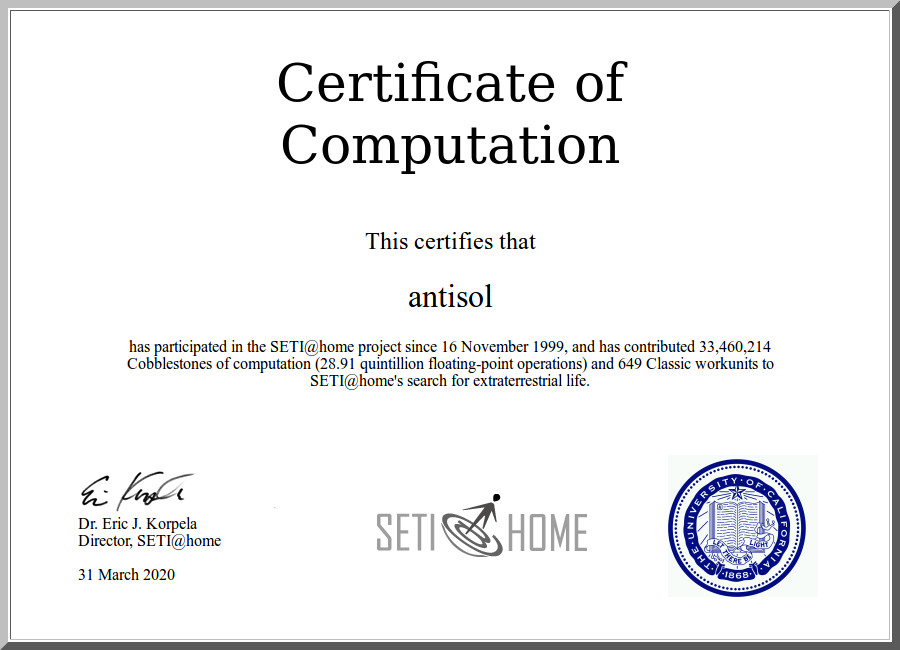
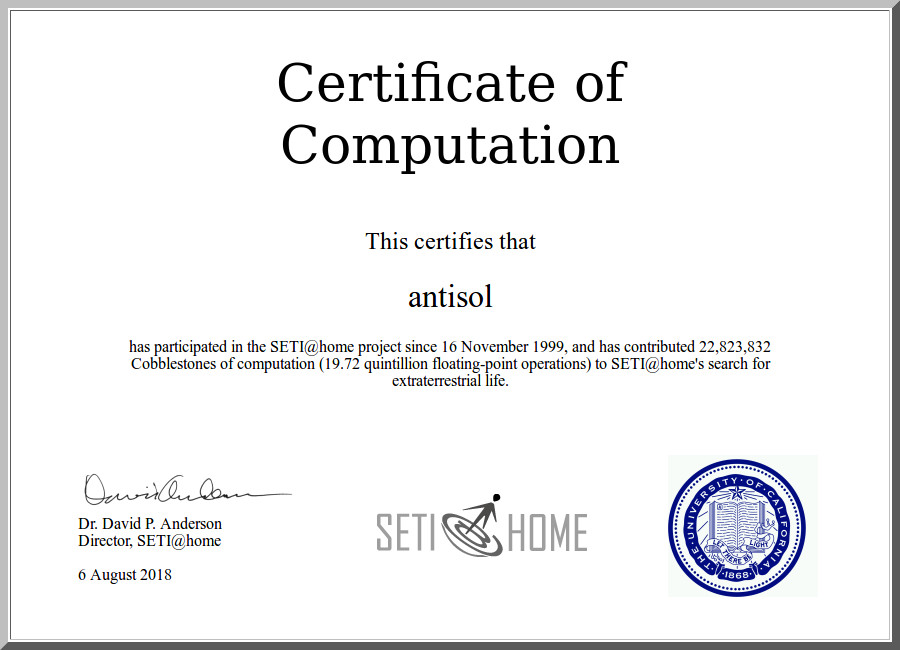
I was fortunate enough to be able to spend a few quintillion floating point operations processing data from Aricebo as part of the seti@home project.

I always wanted to visit it. Now that will never happen.

I’d bet good money that if they’d had the funding they needed for the last 15-20 years, they probably could have prevented the collapse.

But don’t worry, that funding totally went where it was needed: researching new ways to blow cunts up. So yay progress!

Self-Transforming Machine Elves

Excerpts from this article, where Terrence Mckenna describes the “Self-Transforming Machine Elves”, or “Jeweled, Self-Dribbling Basketballs” – nonhuman entities many people claim to have encountered during a DMT experience. The whole article is worth reading, but I’ve edited it down here to remove most of Terrence’s trademark rambling (and delightful) style of talking to keep it to just a description of the entities. Mainly because I was reminded of the somewhat-famous ending quote and I wanted it on my blog:

DMT does not provide an experience that you analyze. Nothing so tidy goes on. The syntactical machinery of description undergoes some sort of hyper-dimensional inflation instantly, and then, you know, you cannot tell yourself what it is that you understand. In other words, what DMT does can’t be downloaded into as low-dimensional a language as English.

The place, or space, you’ve burst into—called “the dome” by some—seems to be underground, and is softly, indirectly lit. The walls are crawling with geometric hallucinations, very brightly colored, very iridescent with deep sheens and very high, reflective surfaces—everything is machine-like and polished and throbbing with energy.

But that is not what immediately arrests my attention. What arrests my attention is the fact that this space is inhabited—that the immediate impression as you break into it is there’s a cheer. [...] You break into this space and are immediately swarmed by squeaking, self-transforming elf-machines…made of light and grammar and sound that come chirping and squealing and tumbling toward you. And they say, “Hooray! Welcome! You’re here!” And in my case, “You send so many and you come so rarely!”

The elves, or “jeweled self-dribbling basketballs,” come running forward. They’re “singing, chanting, speaking in some kind of language that is very bizarre to hear, but what is far more important is that you can see it, which is completely confounding!” And also, something is “going on” that over the years McKenna has come to call luv—”not ‘light utility vehicle,’ but love that is not like Eros or not like sexual attraction,” something “almost like a physical thing,” “a glue that pours out into this space.”

Each “elf-machine creature” “elbows others aside, says, ‘Look at this, look at this, take this, choose me!’” They come toward you, and then—and you have to understand they don’t have arms, so we’re kind of downloading this into a lower dimension to even describe it, but—what they do is they offer things to you. You realize what you’re being shown—this “proliferation of elf gifts,” or “celestial toys,” which “seem somehow alive”—is “impossible.” This “state of incredible frenzy” continues for about three minutes, during which the elves are saying:

“Don’t give way to wonder. Do not abandon yourself to amazement. Pay attention. Pay attention. Look at what we’re doing. Look at what we’re doing, and then do it. Do it!”

End Of An Era

In the next day or so, the seti@home project goes into “hibernation”.

I’ve been contributing my spare CPU time to this project for over 20 years. More than half my life. A whole bunch of posts on this blog are about seti@home milestones.

I’m pretty avid about it, because I think that SETI is probably the single most important bit of science we can be doing. That’s a whole discussion, perhaps for another day.

I keep track of the statistics on an irregular basis. I contribute as much as possible, including donating CPU time of servers and workstations I control.

I’m the number 49 contributor in the country. I’m glad that I managed to crack the top 50 (this happened fairly recently) before the project shut down.

I also managed to crack the 99.9th percentile – I’ve accumulated more credit than 99.90051% of all SETI@Home Users. This is also a fairly recent development. I’m also glad that I managed to crack three-nines before the project shut down.

I’m ranked 1,797 out of 1,806,205 in the world.

I’ve contributed 28.91 quintillion floating-point operations:

Suffice to say that it’s something that I’m passionate about. My Drake Equation simulator is an example of that.

I’m… displeased… by this development.

The announcement that the project is going into “hibernation” came less than a month ago. Here’s the stated reasons:


We’re doing this for two reasons:

1) Scientifically, we’re at the point of diminishing returns; basically, we’ve analyzed all the data we need for now.

2) It’s a lot of work for us to manage the distributed processing of data. We need to focus on completing the back-end analysis of the results we already have, and writing this up in a scientific journal paper.

With regard to point one: My drake equation simulator, and common sense, tells me one thing about SETI: it’s a long-haul game. Given the size of the galaxy and the delays in communication between stars, any communication with extraterrestrial intelligence is going to be a slow process. Another important factor is that given the size of the galaxy, if an alien civilization starts broadcasting today, the likelihood is that it’s going to be thousands of years – perhaps even a hundred thousand – before we receive that transmission. And that’s only taking civilisations in our galaxy into account. The SETI project might run for hundreds of years and not find anything. And it should. A couple of decades for a project like this is an infinitesimal blip compared with the timespans we’re talking about with regard to extraterrestrial intelligence. If you’re going to make the claim that “we’ve analyzed all the data we need for now”, then that can only mean one of two possibilities: 1: You’re not actually doing SETI, or 2: you don’t know what the fuck you’re talking about. There is new data coming in every second of every day. That first signal we detect could be tomorrow. Or it could be a thousand years from now. If we stop looking it’ll be never.

Some fuckwitspeople argue that running a project like SETI is expensiveblah blah blah. They seem to think that because we haven’t found anything in a few decades (well, nothing definite – we have found a couple of interesting and unexplained signals, the Wow! Signal being the most famous) that we should save our money and give up. This is ludicrously short-sighted thinking. The SETI project needs to be a LONG-term project. In the hundreds or thousands of years. It’ll take a hundred thousand years of SETI before we can say that we’re (probably) the only intelligence in the galaxy, and even then we could get a signal the next day. And no result is a result where SETI is concerned – not getting signals gives us some indication of the rarity of intelligence (or, at least, EM radio tech) in the galaxy.

As for point two, this basically boils down to “we’ve decided we can’t be bothered”. If it’s a lot of work then that means you haven’t automated it properly. Writing this up as a paper? What I’m hearing is “it’s more important that I get published than answering one of the most important and fundamental questions out there”. I’ll be expecting to see my name attributed on the paper.

There are nearly 2 million seti@home users. Lots of us are computer nerds. I’m sure you could have found some volunteers to do all that hard work you can’t be bothered with any more. I’d be happy to do as much as I can. But you didn’t ask, instead you just shut down a project that I’ve been invested in for most of my lifetime.

Obviously, seti@home isn’t all of SETI, obviously there will be a bunch of other SETI being done. The Breakthrough listen project is doing some great stuff. But this is a blow to science. Seti@home was a pioneer of distributed computing. And I think that the way it’s being shut down is a huge disservice to science and to all the people who have volunteered our processor time and electricity over the decades. I’m not impressed.

My machines, on the other hand, will be relieved. Their processors will be running much cooler from now on. I’ll go through processor fans much less quickly. And my wallet will probably appreciate the reduction in electricity consumption: I’ll be interested to see the difference in my power bill. I wouldn’t be surprised if it’s noticeable.

Half

As of today I’ve spent half my life contributing to SETI@home!

I’m ranked #2241 in the world in terms of total CPU time donated, and #62 in Australia. In terms of active users, I’m ranked #985 out of 1,738,452 in the world.
Stats

New Horizons

Congratulations to NASA for the first ever Pluto flyby!

I’m days late in saying this, but I was watching events unfold live via NASA TV. I’ve been anticipating this all year, and it’s awesome to finally see Pluto up-close. Great Job! I can’t wait to see more as more data slowly streams back from nearly 5 billion km away.

Links:

  • DSN Now! – see what spacecraft the Deep Space Network is communicating with in realtime. While streaming NASA TV, I was also watching this for a signal from New Horizons as it phoned home.
  • New Horizons Website – had counters telling us when the flyby happened, then when the phone-home signal was expected, and now has a “time since flyby” counter. Also news and images.
  • NASA TV – it’s not just interesting to watch when there’s a major mission going on.